Qobuz vs Spotify: Which streaming service actually deserves your money?
The difference between them comes down to one question: are you listening to music, or just hearing it?


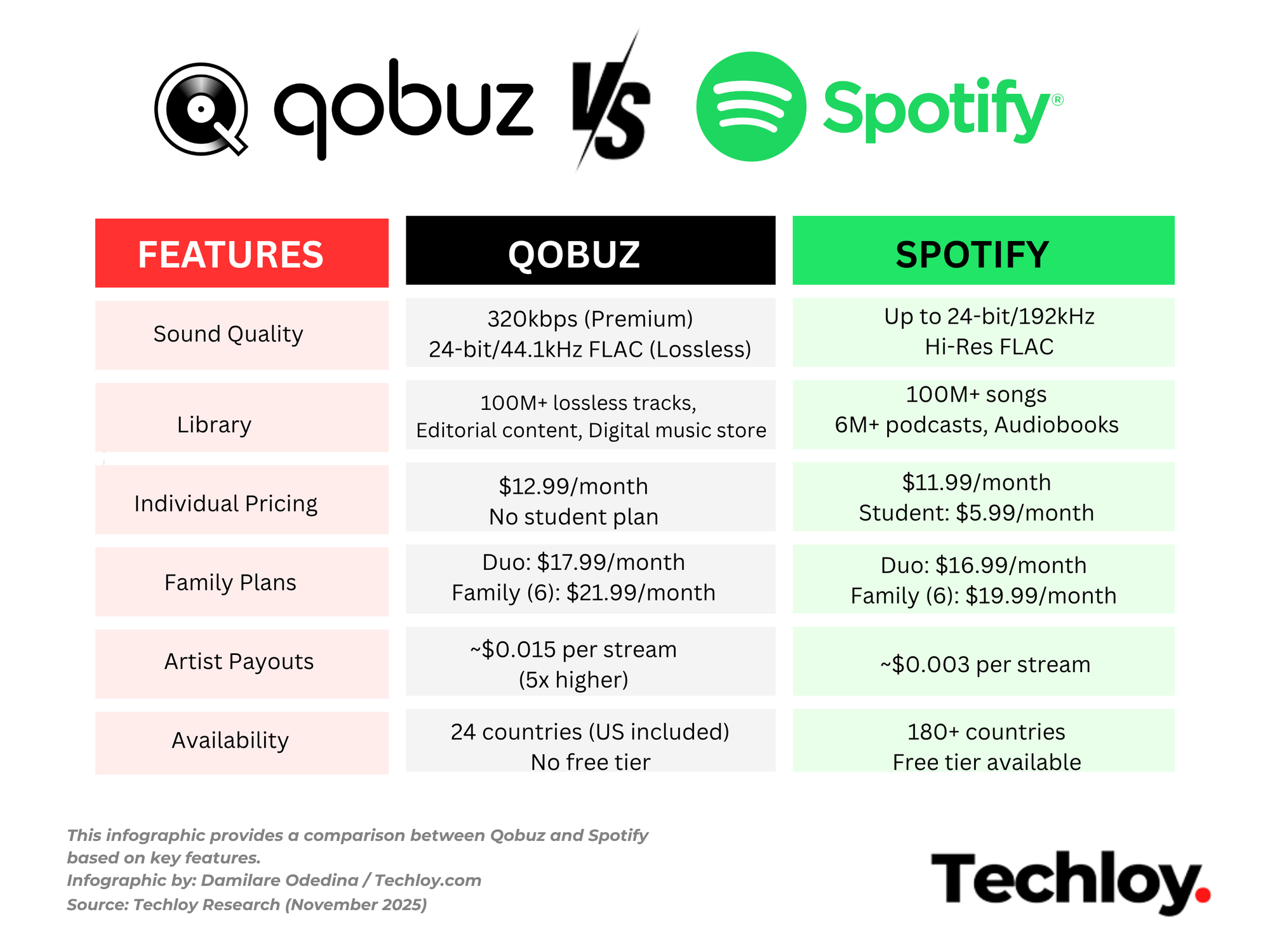
Here’s a reality check: most people can’t tell the difference between streaming qualities. But if you’ve ever wondered why your favorite song sounds flat through your expensive headphones, the answer might be simpler than you think, Spotify streams at up to 320kbps for Premium users, while Qobuz delivers lossless audio up to 24-bit/192kHz Hi-Res quality.
Sound quality: The gap just narrowed
For years, Qobuz dominated this category without competition. But Spotify finally launched lossless audio in September 2025, offering 24-bit/44.1kHz FLAC to Premium users. Still, Qobuz streams at higher resolutions up to 24-bit/192kHz – the difference is noticeable if you have high-end equipment.
What does this mean practically? With Qobuz, you’ll hear details in songs you never knew existed, the breath between vocals, subtle instrument layers, the actual room acoustics from the recording session. Spotify’s new lossless is solid, but it stops where Qobuz just gets started.
Music discovery: Spotify crushes it
Where Spotify truly dominates is finding music you’ll love before you even know you want it. The platform’s Discover Weekly and Release Radar playlists have been refined over years of data collection. Qobuz’s “My Weekly Q” discovery feature often misses the mark completely and can be funny sometimes. If discovering new tracks matters to you, this isn’t even close.
Pricing: You get what you pay for
Spotify Individual costs $11.99/month, while Qobuz Studio Solo is $12.99/month. That extra dollar buys you significantly better sound quality. But here’s what matters more: Qobuz pays artists approximately $0.0187 per stream compared to Spotify’s $0.003, meaning your money goes further for the artists you love.
The real difference? Spotify is available in 180+ countries with a free ad-supported tier, while Qobuz only operates in 24 countries (including the US) and requires a paid subscription.
The verdict
Think of it this way: Spotify is for discovering music, Qobuz is for experiencing it. With over 100 million songs, podcasts, and audiobooks, Spotify wins on content variety and convenience. But if you’ve invested in quality headphones and actually care about audio fidelity, that extra dollar for Qobuz is worth every cent.


